Shop · Hokusai prints

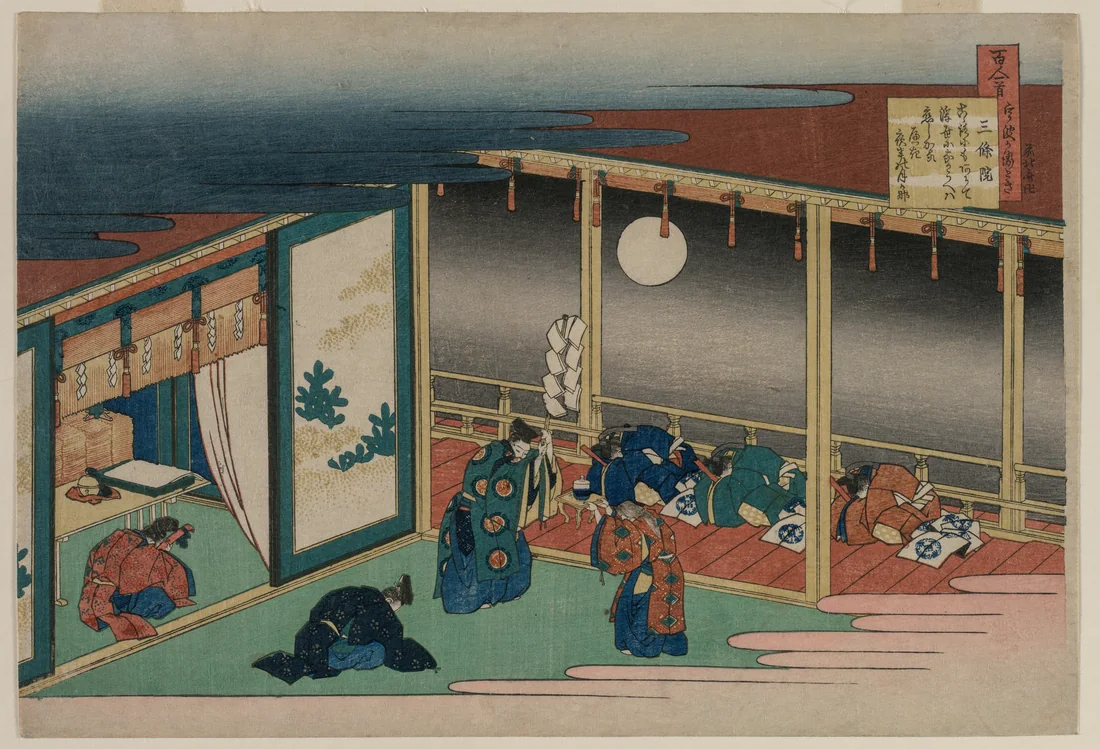
Poem by Emperor Sanjo by Katsushika Hokusai, 1835–36 – art print
Drawn to scale. Choose a size and frame to see it change.

Katsushika Hokusai

Poem by Emperor Sanjo

1835–36 · art print

our suggestion 70 × 50 cm, Gallery box frame, natural wood

It is printed on warm, cream-coloured paper. Natural wood picks up that warmth; a white frame would make the paper look yellowed next to the white mount. At 70 × 50 cm the image is 60 × 40 cm inside the mount, large enough for the detail; at 40 × 30 cm it would be 30 × 20 cm. For a large wall, 100 × 70 cm.

Size
Finish
Frame colour

2 149 kr incl. VAT, delivery included

Size
Frame 70 × 50 cm (28 × 20 in), image 59 × 40 cm inside a 5 cm white mount
Paper
Matte fine art paper (Enhanced Matte Art), 200 g, printed to order
Framing
Assembled, with a 5 cm acid-free white mount. Frame sizes are the mount's outer size; the profile adds 2 cm on each side
Delivery
Included, 5–10 working days
Returns
14 days. Terms
Source
Cleveland Museum of Art, 1985.326 (CC0)

Got a frame already? The unframed print fits a standard frame size. A new picture for a frame you already have

About the work

Poem by Emperor Sanjo is a colour woodblock print by Katsushika Hokusai, dated 1835–36. It belongs to the series One Hundred Poems by One Hundred Poets Explained by an Old Nurse. Katsushika Hokusai (1760–1849) was a Japanese painter and printmaker whose career lasted some seventy years. His series Thirty-six Views of Mount Fuji, with The Great Wave, made him one of the best-known artists in the world. The original is in the collection of Cleveland Museum of Art.

Katsushika Hokusai · Poem by Emperor Sanjo · 1835–36 · Colour woodblock print · Ukiyo-E

More: All Hokusai prints

Why it stays with you

At 76, Hokusai began a hundred prints on a famous anthology of poems; only 27 were published, probably because of a great famine. The series' title says a nurse explains the court poems to a child with everyday pictures. Emperor Sanjō's poem says, roughly: if I live on in this sad world against my will, I will remember this midnight moon.

Hokusai shows a moonlit ceremony on a veranda. A priest raises a staff hung with white paper strips, the brightest thing in the picture, against dark bands of cloud, and the bowed backs make a stillness that reads as sorrow without a single tear.

Dark, with small figures and one white accent, it rewards a low lamp and a second look.

Sources: Cleveland Museum of Art · Smithsonian
More stories behind the paintings