Shop · Van Gogh prints

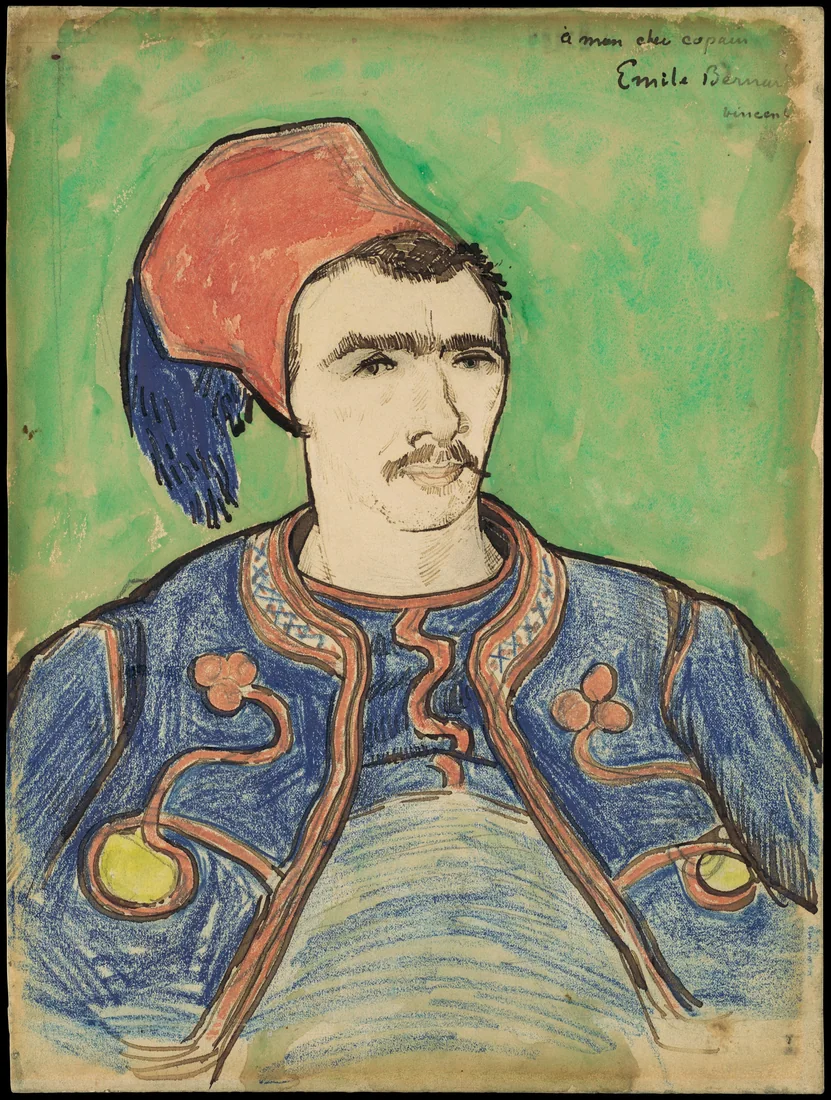
The Zouave by Vincent van Gogh, c. June 20, 1888 – art print
Drawn to scale. Choose a size and frame to see it change.

Vincent van Gogh

The Zouave

c. June 20, 1888 · art print

our suggestion 30 × 40 cm, Gallery box frame, natural wood

Greens and earthy yellows: natural wood sits easily with them. This work comes in 30 × 40 cm; framed, the image is 20 × 30 cm inside the mount.

Size
Finish
Frame colour

1 449 kr incl. VAT, delivery included

Size
Frame 30 × 40 cm (12 × 16 in), image 20 × 26 cm inside a 5 cm white mount
Paper
Matte fine art paper (Enhanced Matte Art), 200 g, printed to order
Framing
Assembled, with a 5 cm acid-free white mount. Frame sizes are the mount's outer size; the profile adds 2 cm on each side
Delivery
Included, 5–10 working days
Returns
14 days. Terms
Source
The Metropolitan Museum of Art, New York, 62.151 (CC0)

Got a frame already? The unframed print fits a standard frame size. A new picture for a frame you already have

About the work

The Zouave is a reed pen and brown ink, wax crayon and watercolour, over graphite on wove paper by Vincent van Gogh, dated c. June 20, 1888. Vincent van Gogh (1853–1890) was a Dutch Post-Impressionist who made around 2,100 works in little more than ten years. His thick brushwork and bold colour came to full strength in Arles, Saint-Rémy and Auvers. The original is in the collection of The Metropolitan Museum of Art, New York.

Vincent van Gogh · The Zouave · c. June 20, 1888 · Reed pen and brown ink, wax crayon and watercolour, over graphite on wove paper · Post-Impressionism

More: All Van Gogh prints

Why it stays with you

In June 1888 a downpour stopped Van Gogh painting the harvest in Arles, so he painted a soldier instead, his first portrait in the south. He described its colours to his brother as “a savage combination of incongruous tones”. This is a colour study after the painting, sent to his friend Émile Bernard; the sitter's name is not known.

Three pairs of opposite colours sit side by side at full strength, blue against orange and red against green. The edges seem to vibrate and the face glows, and the figure is cropped so tightly that the red fez almost touches the top.

It is the opposite of a quiet print, and that is the point: one strong face, close up, that wakes a room.

Sources: The Metropolitan Museum of Art · Letter 501
More stories behind the paintings